
01
Less streak guilt, more useful insight
When the streak breaks, you don't get a sad emoji - you get a short reflection on what was different that day. The tracker becomes a tool, not a tax.
Most habit trackers count streaks and call it a day. DailyLens tracks the routines you actually did - sleep, walks, focus blocks, breathwork - and joins them with how the day felt in your own words. Then the AI writes back the pattern. Yes, your streak still lives - now it stands next to the why behind it.
A simple log of what you actually did, captured in seconds. The flame follows the work, it doesn't lead it.
The pattern joins what you tracked with what you wrote - so a missed day teaches you something, not just resets a counter.
For adults who already know they should sleep better, walk more, and focus longer. For people who tried streak apps and ended up gaming the streak. For anyone who wants a habit tracker that helps them think, not perform.
When the streak breaks, you don't get a sad emoji - you get a short reflection on what was different that day. The tracker becomes a tool, not a tax.
Routines and entries are joined in the same window, so the AI can call out the recurring shape: 'energy crashed on the days you skipped breakfast.' That's something you can act on.
Each evening, DailyLens turns your routines and notes into a short summary with one realistic next step. No spreadsheet, no 12-bullet AI essay.
Offline-ready PWA, fast capture, and tiny rituals mean the routines still get logged on the days you would normally drop them.
Streak apps count. Notion habit databases require a part-time job. Generic mood trackers see your mood but not your routines. DailyLens reads both - the routines you tracked and what you wrote about the day - in the same window.
You optimize for protecting the flame, not for understanding what your day was actually doing. The day the streak breaks, the app has nothing useful to say.
By the third busy week the database becomes a guilt trip. The point of a tracker is to disappear into the day, not become another tab to maintain.
Mood without routines is sentiment. Routines without context are checkboxes. Neither one alone names the pattern that drove the day.
Tap, done. A 30-second voice memo or three lines on top of the routines you ticked. Capture should not feel like writing an essay at 11 PM.
Each reflection is prompted with both your tracked routines and your recent written entries, so the AI can name a pattern instead of a mood or a streak.
Routines and notes are scoped per user and encrypted in transit. Your habit log isn't a public training feed.
DailyLens is a tracking loop with two halves. You log the routines you actually did - that's the structured half. You write or speak about the day - that's the unstructured half. The AI joins them in a recent rolling window and writes back what changed and why. That's the whole product.
Walks, sleep windows, focus blocks, breathwork, supplements - check them in one tap from a customizable list. Your routines, your day, your taxonomy.
Voice memos sync, get transcribed, and become editable text entries. Typed notes persist locally first, then sync. Both sit alongside the routines in the same per-account store.
Reflections are prompted with your routine completions plus recent entries. That's why the AI can say 'the days you skipped X also had Y,' instead of just counting the streak.
Each evening compiles into a short daily report. Each Sunday compiles into a weekly arc. Both read the same window, so they show shape, not noise.

Open the app, tap the routines you're committing to today. No 12-step planner, no streak shaming - just the small set of things you said you'd do.

Tap to mark a routine done. Speak a 30-second note when context matters - 'walk skipped, brain dead' - and move on. The log should disappear into the day.

End of day gets a short AI reflection that joins your routines with what you wrote: which routines actually held, which slipped, and the recurring pattern across the week.
A loop that survives long meetings, hard parenting nights, and weeks where the only available tracking time is 47 seconds before the kids wake up.
A short, customizable list of routines - walks, sleep, focus blocks, breathwork. One tap each. The tracker accepts the smallest possible signal instead of demanding a perfect dashboard.
On the days a routine slipped, a 30-second voice memo gives the AI something to read. The note becomes a normal text entry you can fix tomorrow.
Each evening and each Sunday, DailyLens joins your routines and entries into a short report with one realistic next step. The tracker becomes a dashboard for your own life, not another spreadsheet.
Articles on routines, willpower, recovery, and how reflection actually changes behavior - the same lens that shapes how DailyLens reads your week.
Discover how a simple 10-minute evening planning ritual can cut procrastination by 30% and boost focus, energy, and performance. Backed by habit science, this guide offers practical protocols and a journaling template to help you start tonight.
Read articleProcrastination often relieves discomfort in the moment. Learn how to identify the emotion behind avoidance, lower the cost of starting, and change the pattern.
Read articleDiscover why dual-income parents crash by evening and the simple daily system that restores energy for the moments that matter most.
Read articleLearn how cognitive offloading reduces mental clutter, protects focus, and helps overloaded professionals build a calmer, more intentional workday today.
Read articleFeatures
Use each tool on its own or together with the others, on your phone or computer. Start with one and add more as you need them.
Speak instead of typing. Each recording is saved as a journal entry and transcribed in the background, within your plan's limits. Voice analysis is part of Pro.
Related: ADHD and focus support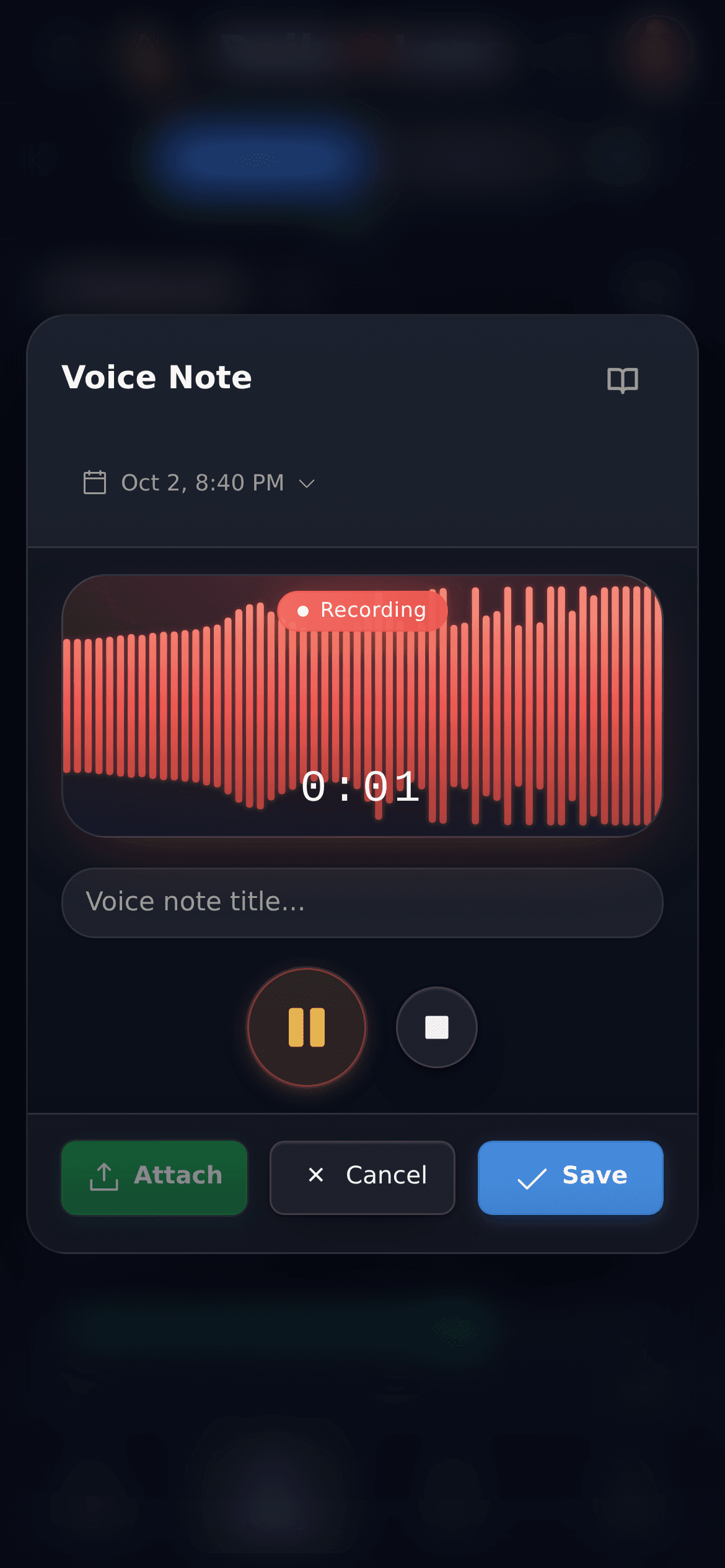
Write a few lines or a full formatted entry and add your mood. Text entries are saved on your device first and sync once you are online.
Related: AI journal app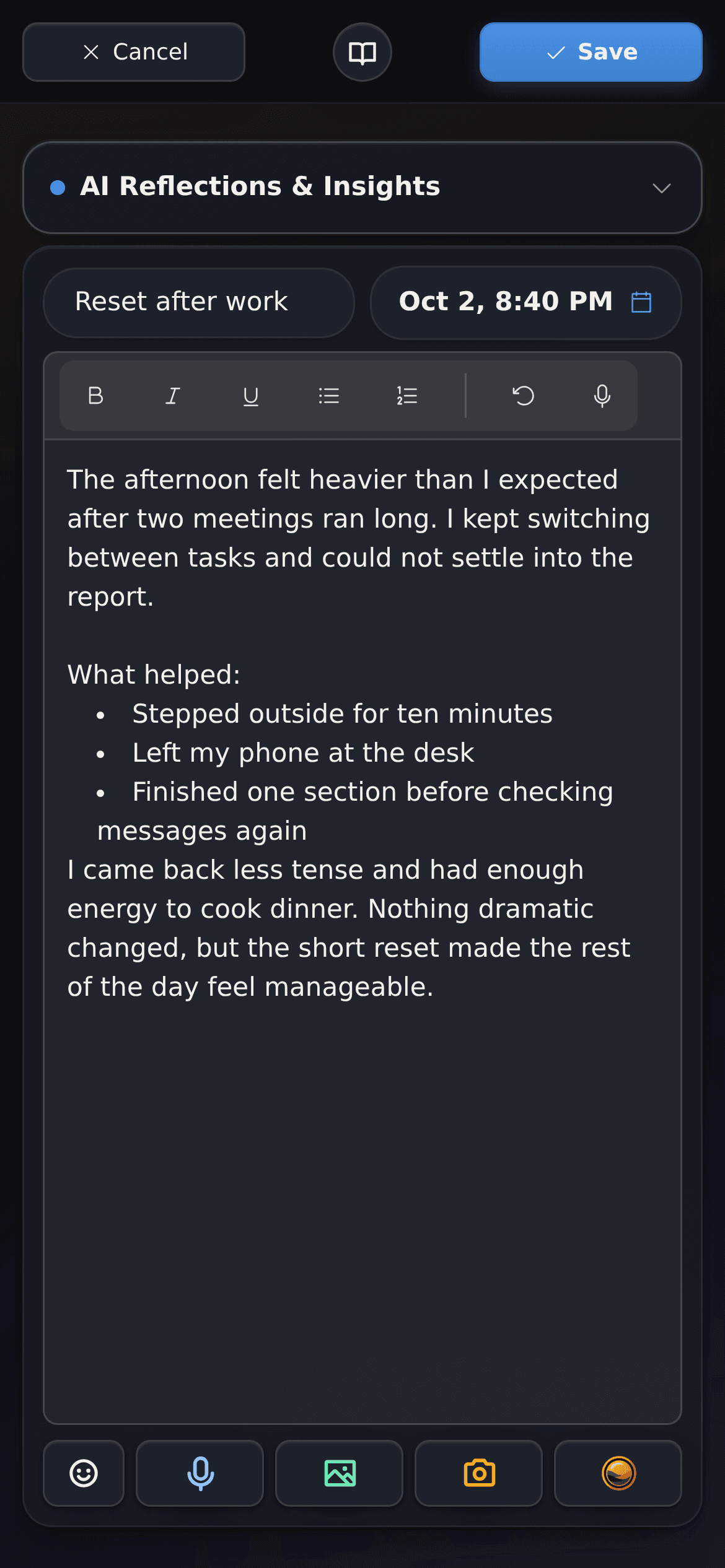
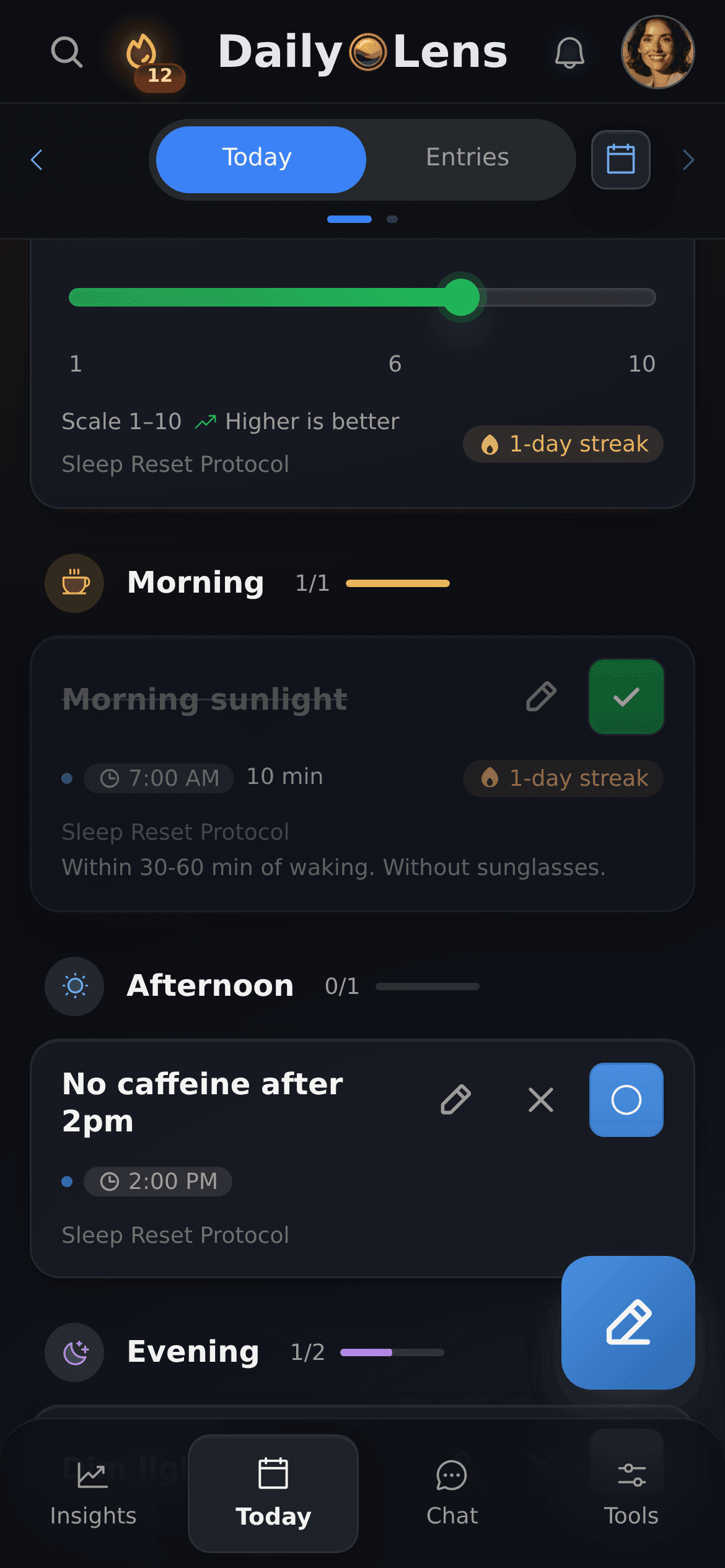
The Today tab groups your practices by time of day, from wake-up to bedtime. Mark each one done and see your protocol progress and streaks.
Open Quick Track from the + button and rate sleep quality, energy, or anything else you track in a few taps.
Related: More energy after work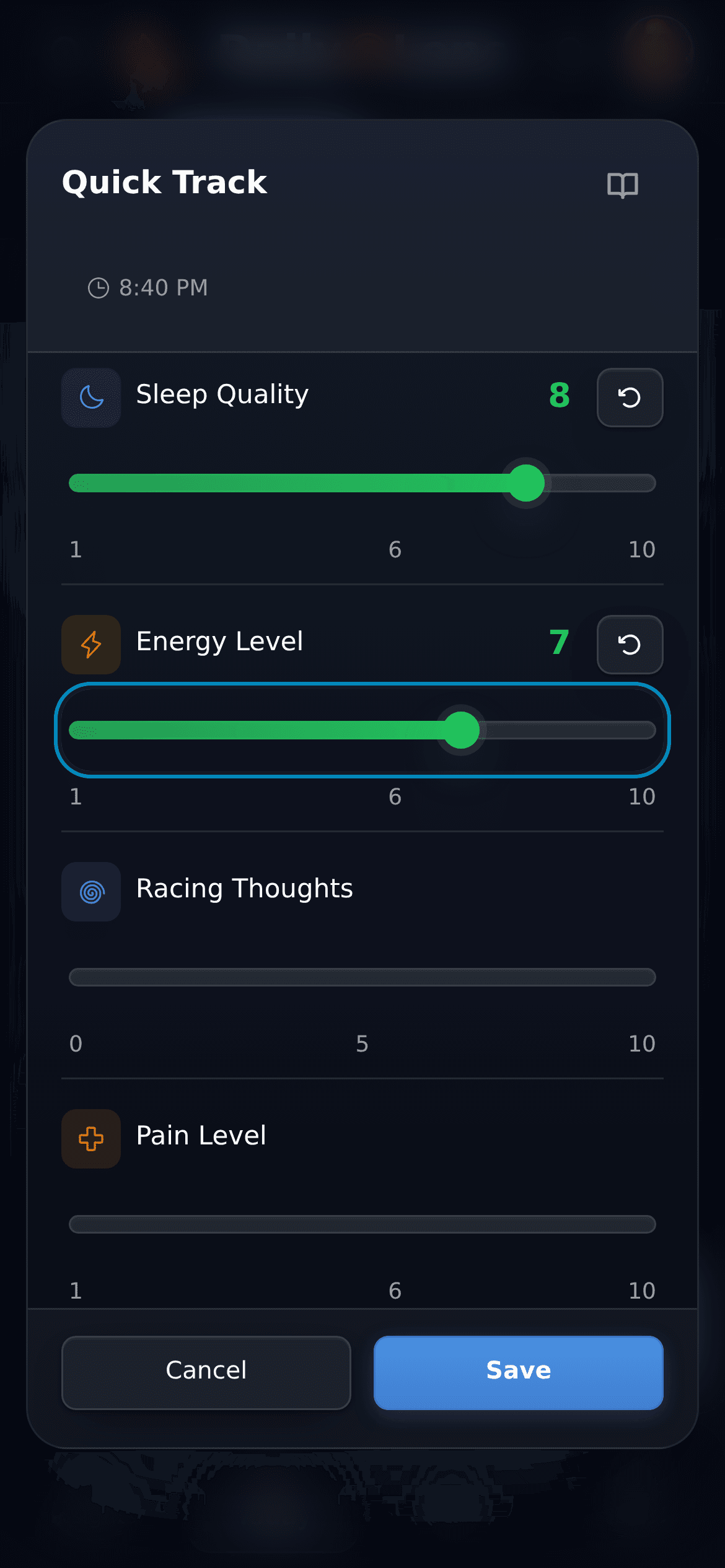
Start from a ready-made protocol, such as a sleep reset, or build your own with steps for specific times of day.
Related: Protocol tracker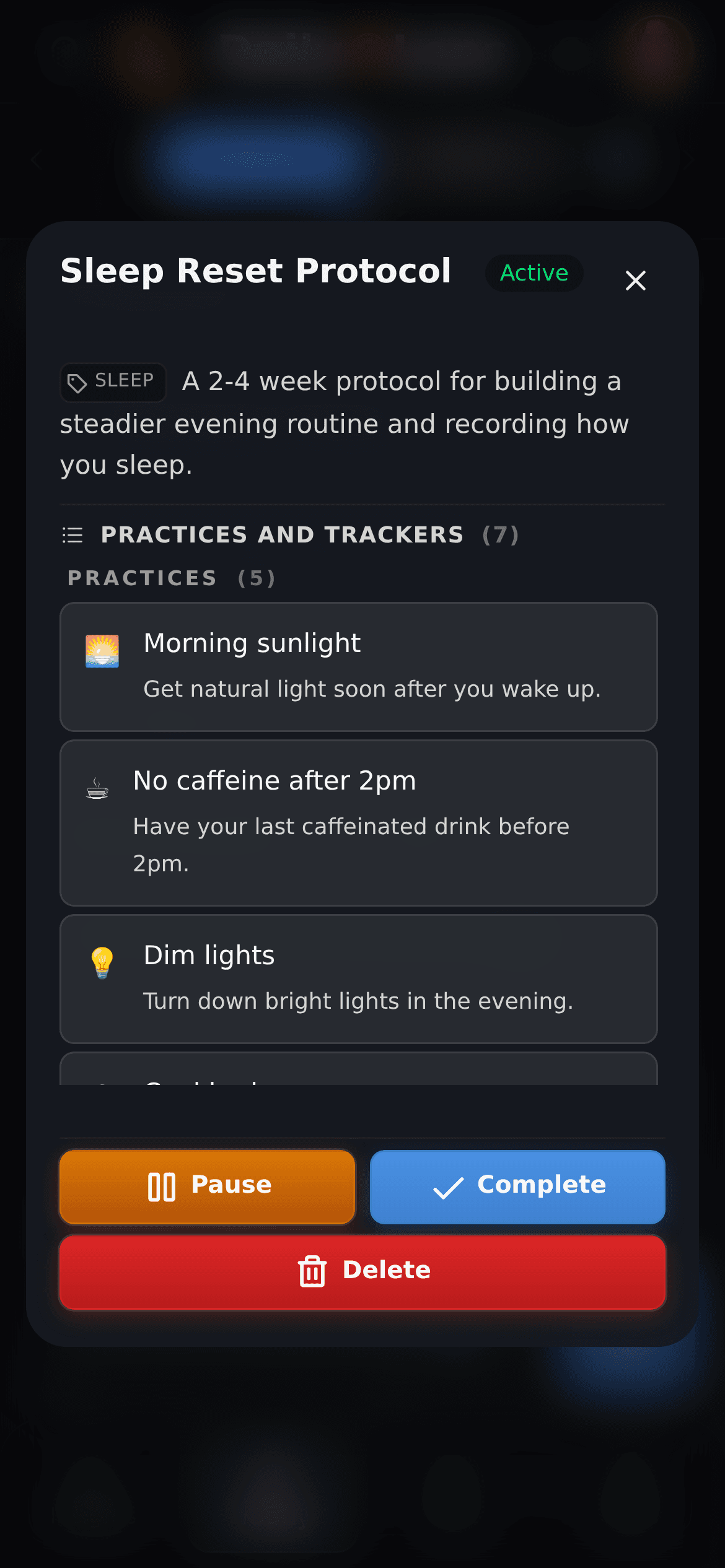
See your consistency, mood, and activity over recent days. On eligible plans, you also get daily and weekly reports on what you recorded.
Related: Biohacking and performance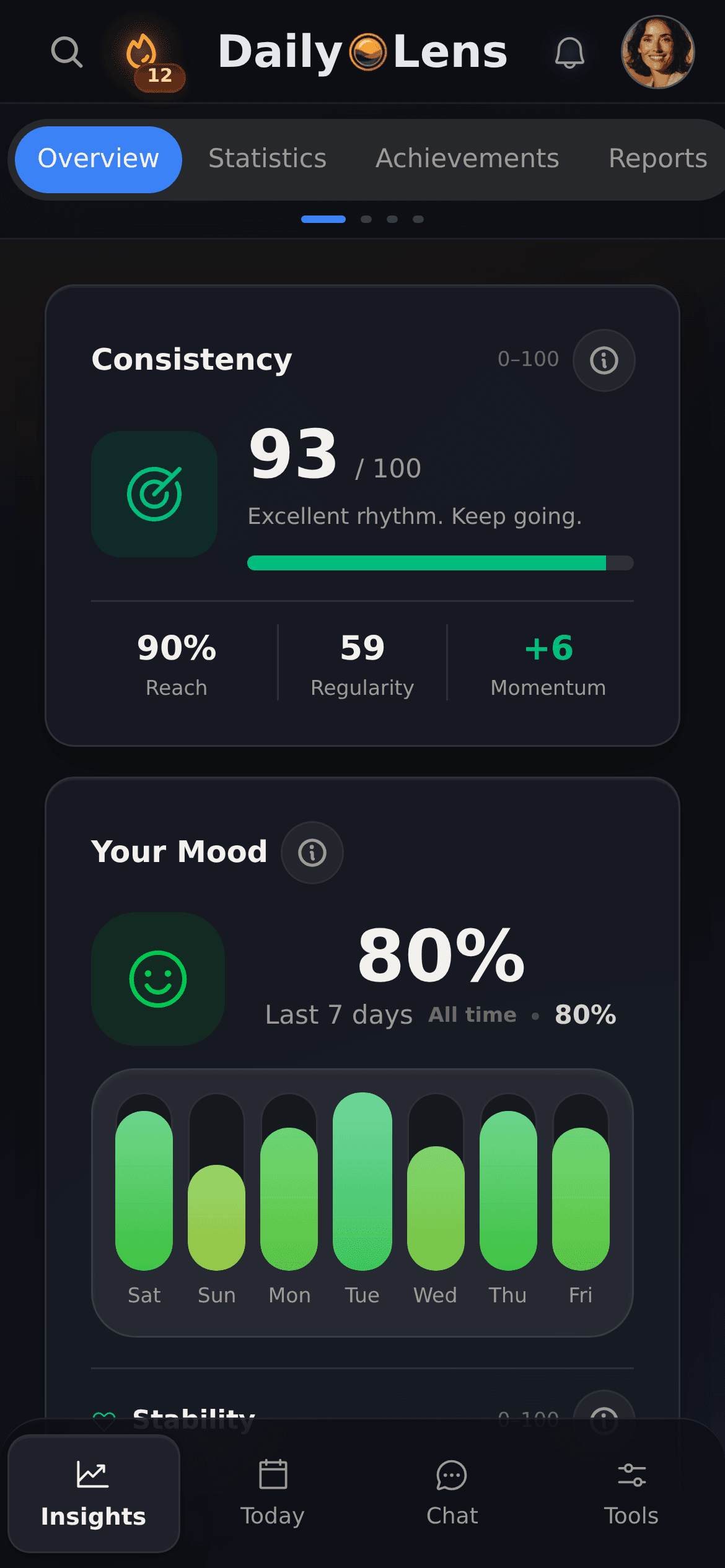
Ask about your recent entries and routines. Suggested changes are applied only after you approve them.
Follow box breathing, 4-7-8, or belly (diaphragmatic) breathing with on-screen guidance for each phase.
Get optional morning and evening reminders at times you choose.
Use DailyLens in your browser or install it on your phone or computer. You can write text entries offline.
Voice transcription and custom protocols have limits on the free plan. AI chat, reports, and voice analysis are part of Pro.
Short, direct answers.
A streak app counts. DailyLens reads. When the streak breaks, a streak app sends a sad emoji - DailyLens joins your tracked routines with your recent written entries and writes back what was different that day. The point isn't to protect the streak; the point is to understand the pattern.
Yes. You build the list of routines that actually matter to you - walks, sleep windows, focus blocks, breathwork, supplements, anything. The tracker is your taxonomy, not a fixed set of habits we picked.
No. You can use DailyLens as a clean habit tracker without ever writing a word. Reflections become more useful when there's some context attached, but they're optional - and they read the routines either way.
No. Routines and entries are scoped to your account and encrypted in transit. Reflections are produced by prompting a foundation model with your data at request time; that data isn't reused as a training set.
Tracking does. Reflection doesn't. Routine completions and notes are written to your device first, so logging on a plane is fine. The reflection step needs the model and runs when you're back online.
No. DailyLens describes patterns in your own data ('your energy dipped on the days you skipped the walk'). It doesn't diagnose, prescribe, or replace a clinician. We're explicit about that in product, not only in legal text.
Yes. DailyLens exposes an MCP API you can connect to your editor, agent, or toolset to read and write routines and entries within your account scope. It's the same surface our own agents talk to, with per-account auth - your habit log becomes a first-class data source for whatever you're already building.
Try the habit tracker that explains why you slip. Join the early access list.
One product, different starting points. Choose the topic closest to what you want to understand or improve.
Track repeatable protocols and supplements alongside how your day actually went.
For adults who find task initiation, lost threads, or overstimulation difficult to manage.
Review recent entries with AI assistance when your plan and recorded context support it.
Use short practices and recovery routines, then review what tended to drain or support your energy.
Organise morning, sleep, and focus protocols into clear steps and schedules, then record what changed.